|
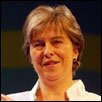
Theresa May MP - Shadow secretary of state for the family
Question: You've described the government's plans to change the laws governing child custody as papering over the cracks – what are your plans in this area?
Theresa May: We would do something quite different. If I could just set the background, because what the government is doing is taking the way the current system operates and just tinkering it at the edges, just changing it slightly.
I want to reform the way the whole system operates. There are two key things in that - the first is to introduce a legal presumption of co-parenting. Now that doesn’t mean 50-50; often people say: "Oh you can't split a child 50-50." It doesn't mean 50-50. It means that both parents should be involved in the upbringing of the child and the child can be in a relationship with both parents, so you need proper contact time to enable that to happen.
So we'd have a legal presumption of co-parenting, and then we'd back that up with compulsory mediation, which would involve trained mediators sitting down with parents and working through with them the sort of contact time and parenting arrangements that would be suitable in their circumstances, with some guidelines.
I think the current situation is crazy. There are no guidelines to the amount of time. I know every family is different, but there are some similarities between circumstances. What it does is focus the parents on the children's needs very clearly at an early stage. What happens elsewhere is that far fewer cases need to go to court, because the parents sit down and they make a plan that would work for the children.
Question: Has this been costed?
Theresa May: What we would do is abolish CAFCASS (the Children and Family Court Advisory and Support Service) because we think this work is different to the sort of work that CAFCASS does at the moment. We'd be using that to invest in the new service.
Question: Are you concerned that an issue affecting a relatively small number of cases is receiving a disproportionately large amount of attention when in most cases the problem is that the absent parent has voluntarily stopped financial supporting and seeing the child?
Theresa May: One can look at the figures for the number of cases that end up in bitter disputes in court and it is obvious that is not the majority of cases by any means.
However, there is some evidence that there are a number of other cases where parents on the surface appear to have come up with an agreement, but actually the non-resident feels that they've had to back off and they haven't got the contact they want.
A while back a father was talking to me about this and said he was trying to gain more access to his child, but eventually the solicitor had just said to him: "Look, you're beating a brick wall with this system, it's not worth carrying on trying."
So I think there are quite a few non-resident parents who actually would like to have more of a role in the upbringing of children, but for various reasons. Our system would help them as well.
Question: The Liberal Democrats have recently announced plans to improve maternity leave packages for working mothers – what is your opinion of these plans?
Theresa May: Well, what we have put forward is a proposal to give people a choice as to what they do. The government is saying: "Let's extend people's payments up to nine months and eventually up to a year, but initially up to nine months rather than six months."
We're looking at whether we can operate a system whereby mothers are given a choice of taking the payment and extending it over nine months, or in fact front-loading that money, to get more money in the first six months. So we're looking at operating a more flexible system for mothers, giving them a bit more control over what they want to do.
Question: Is there a tension for the Conservatives in being a family-friendly party and the party of business?
Theresa May: Well, some people say there must be a tension. I think these days that the tension is far less pronounced than perhaps it might have been in the past because employees are increasingly looking for flexibility from their employers, to offer them flexible working and in some cases extra childcare benefits.
Most notably in the IT/telecoms sector, I think there are an increasing number of companies where the feeling is: "Well if we didn't offer flexible packages for our employees they wouldn't be our employees, they'd be moving on to the next company."
So people's demands are much greater. Nortel, which is based in my constituency, has about a third of its employees on home contracts rather than office-based contracts, so they're offering real flexibility to their employees.
Question: What do you hope to achieve at this year's spring conference, as the last meeting of members before the next general election?
Theresa May: What I hope will come out of that is that people will see, from the Conservative Party's point of view, that we've been focusing on the issues that really matter to them; they will see that there is a clear difference between us and the Labour government not just in the policies that we're proposing and the whole approach we're taking to government.
It's about saying to people: "Government should be honest to people about what it can and can't do, we should be accountable to people."
At the party conference Michael Howard announced that we'd set out a timetable for action in government and he made it absolutely clear any Conservative Cabinet member who didn't meet the timetable obligations would be sacked. So we have a different approach to accountability.
Focussing on those five key areas that we've identified, we want more police, cleaner hospitals, school discipline, controlled immigration and lower taxes.
Question: What progress is being made on selecting women candidates, and particularly those from ethnic minority backgrounds?
Theresa May: I'm pleased to say that we've got more women standing for the party this time around than we've had before. So that is good news. I think we can still do more, but I think we have been making a lot of progress. And we have got some good women candidates from ethnic minorities as well as other women candidates.
We have our first female Muslim candidate standing in Dewsbury, for example; we have an Asian businesswoman and mother standing in Enoch Powell's old seat. So we have been increasing our representation of women.
I'm pleased that some of the things I put in place when I was chairman - like primary selections, selection process, giving more flexibility for associations in their selection process - have been working in those seats.
Question: To what extent has that been hampered by the deselection of some women candidates?
Theresa May: Sue Catling was deselected in Calder Valley and a woman replaced her. In Colne Valley, where Amanda Harland stepped down, a woman - Maggie Throup - replaced her. In Brighton Kemptown where the male candidate stood down, a woman replaced him, so we're not doing too badly in that sense.
I think the problem is that the media pick up on the deselections of women make quite a negative story of it; they don't comment on when men part company with their seats.
But what's important is that we show on the ground that we've got good female candidates and that they're actually out there and presenting a very good face and good campaign for the party.
Question: What first attracted you to entering parliament?
Theresa May: I'd been interested in coming into parliament for a very long time I have to say, in fact since I was in school. But I did not read Hansard under the bedclothes.
Politics attracted me, but I decided that it was better to do something else before you went into politics. And then I became a local councillor, stood in a couple of seats I wasn't going to win and then carried on and decided that yes this was for me.
What attracted me into it, I think, was wanting to make a difference and being part of the debate. But really as a politician to make decisions to give support to people; as a constituency MP, to really make a difference to people's lives.
Question: How confident are you that the Conservatives can win the next general election?
Theresa May: Well, I am confident that we can win the next general election. I never predict election results, but I'm confident that we can win it and that's because of the mood that I'm now picking up on the doorsteps.
There is a real change and a real feeling from people that Tony Blair has let them down and that they are fed up with all the talk and they want some action.
Question: How vulnerable are key members of the shadow Cabinet, including yourself, to the Liberal Democrats?
Theresa May: Well, I always take the view that you should never be complacent about voters, you should never take anything for granted, you should just go out there and work for your constituency and that's what I try to do week in and week out.
Question: Do you now regret the "nasty party" claim?
Theresa May: No, not at all. I think it had to be said and it was right to be said. And I think there were many in the party who felt that it was right to be said.
Question: What would be a "good result" for Michael Howard?
Theresa May: Well, I don't predict and I don't look at the possibility of not winning, I say we're out there to win.
Question: Since there is no formal Cabinet position of secretary of state for the family, what position would you want to take in a future Conservative government?
Theresa May: I have to say, I've been asked that question when I've been doing roles in which there has been a formal opposite number. I hope the creation of a post in shadow government will lead to a different approach in government, which will be one that says we need to step outside the departmental silos and have people in government who cover a wider remit that brings together strands of policy from different areas.
That's one of the benefits, I think, on family policy. We're able to look across the board. From the people's point of view, they don't see a lot of their needs being catered for by the Department for Work and Pensions, or the Department for Education or the Health department. They need help as a carer, or they need help as a parent and often that help comes from a variety of sources.
This interview also appears in The Parliamentary Monitor
|