|
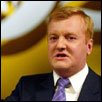
Charles Kennedy MP - Liberal Democrat leader
Charles Kennedy
Question: The Conservatives have a new and re-invigorated Michael Howard in charge. That's bad news for the Liberal Democrats, isn't it?
Charles Kennedy: I don't think that so far. It's early days yet. The man's hardly been in the job a month so you shouldn't jump to conclusions.
I speak as somebody that had to take over a party leadership; I remember what it was like. It's a bit like moving house - you have to get the furniture re-arranged before you can do much else.
I think that Michael obviously brings to the task ministerial experience. He and I have both been MPs for 20 years - we were both elected in 83. We know each other and get on well with each other.
Undoubtedly the Conservative Parliamentary Party is in more buoyant form than it's been for a long, long time. There's no question about that.
A lot of the commentators who are very Westminster-focused are saying 'we're back to traditional two party politics'. I have to say that I've been travelling about the country quite a lot recently and that's not the feeling out there. The opinion polls are not showing any seismic shifts in public attitudes towards politics or the political parties.
Our position remains comfortably above 20 per cent - not just in one poll but on the aggregate of polls over the course of the year.
So no fundamental reassessment of strategy here, we just continue making our case and making more telling points. As, inevitably, the shine comes off after a political leadership honeymoon, people will look in detail at the policies on offer. The more that people will see that happening, the more they will come unstuck.
Question: How do you counter the idea that this is a new Conservative Party?
Charles Kennedy: It's exactly the same cast of characters. They've changed positions at the top, at the leadership level, but it's the same group of people that have been with us for a long, long time. And they bring with them the same political baggage that has always been there from 18 years in government which was so decisively rejected by the electorate six years ago.
I really don't think that the public feel that anything dramatic or fundamental has changed in British politics. Politics remains very up for grabs and that's very good news for us.
Question: Can your party really unseat Michael Howard in Folkestone, given his new high profile?
Charles Kennedy: Folkestone was always going to be a prime target for us, looking at the trend of results in that seat over several elections. And it remains so. It's nothing personal.
The fact remains there is still a significant Labour vote in that seat which knows Labour can't win but knows potentially we could win. What are those voters going to do? That remains to be seen. But we will be giving it a lot of attention along with several other seats that happen to be held by leading lights in the Conservative Party because those are seats that have to be in our sights if we are to progress further at the next election.
Question: Tony Blair has said he's determined to push on with the top-up fees policy. Given he got a result with foundation hospitals, isn't this going to be a repeat?
Charles Kennedy: It's difficult to assess the mood in the parliamentary Labour Party. They're obviously investing a great deal of time and political energy on this.
We'll just have to wait and see what happens over the next few weeks. I'm quite sure there will be more detailed concessions in what's going to be a fairly short bill.
The informed speculation is that they are going to keep the bill as tight as possible to limit the scope for amendments.
The prime minister's upped the ante on the second reading vote. This is rarely the definitive occasion. That usually comes in the report stage. That is when the going gets more sticky rather than the iceberg that's being pointed to by the pundits at the moment. I think that's a bit of a distraction - there's choppy waters beyond that.
Question: How much damage do you think top-up fees will do to the government? Could this spell the end for the prime minister?
Charles Kennedy: I don't know about toppling the prime minister; he's in a very, very powerful position but I think the damage done is the sense of injustice in it all.
We've produced figures from written answers by the government which reveal that if the plans go ahead you're going to have the absolutely untenable situation whereby a graduate who earns £1 above £35,000 a year - when you take into account tax, NI, and student loans - is paying 50 per cent of their income.
That the government must consider to be just because it's their policy. Yet Blair stands up and says in response to me that to tax somebody earning £100,001 a year at 50 per cent on that £1 is unfair.
How can anyone justify that it is completely beyond the pale. That is the issue that we are going to drive home to people and I don't think it will be lost on them.
Question: Tony Blair says your party's spending plans are an uncosted promise to be all things to all people. What's your response?
Charles Kennedy: He's talking garbage - and he knows it. He knows better and he should do better. The fact of the matter is that we have made a very specific tax and spending commitment - the 50 pence top rate on every pound above £100,000. That raises £4.7 billion. With that you can take £2 billion to get rid of tuition fees, don't go down the road of top-up fees and reintroduce fair grants.
In addition we can introduce free personal care for the elderly. These figures are based on the per capita cost in Scotland where we're implementing it with Labour.
At the same time we can provide £1.7 billion - far more generous than Gordon Brown - to alleviate the effect of council tax rises particularly on the elderly.
That's what we do with it. That's the pledge. That's the option. Anything beyond that has yet to be worked through and is aspirational. And we make it clear in every single document we produce.
And he knows that. He's deliberately distorting and misrepresenting and I'm not going to let go of this.
Question: Isn't this part of the cut and thrust of politics. You make a policy pledge and your opponents challenge it?
Charles Kennedy: Well I don't mind the prime minister standing up and saying he disagrees with a 50 pence top rate because he thinks it won't work or there's more important priorities or there's a better way of doing things. That's fine and the marketplace - the electorate - can judge who's right and who's wrong. But what I do object to is coming out with total fabrications about what Liberal Democrat proposals actually are and claiming they're not costed.
Of course the other thing is that if the prime minister and the chancellor are so certain in their economic judgement then, alright, do the same as we have done year upon year: submit your proposals to the Institute for Fiscal Studies - an authoritative, independent, outside body and see if the figures add up. Every time they've given us a clean bill of health. Gordon Brown won't open the books and I think that tells you an awful lot.
Question: Is this going to be one of the key issues for 2004?
Charles Kennedy: I think it's one of the big ones because it's central to their entire social and political approach.
But equally we're not losing sight of the international agenda because you've got the Hutton inquiry coming back in January and that will re-visit all the issues attendant to the war in Iraq; particularly the basis on which the case was made.
I feel increasingly of the view, and I think an awful lot of other people do, that if parliament had known half of the things last March that it does now you might have had a very different situation on that vote.
Question: What's been your take on the Hutton inquiry? Will it be a whitewash?
Charles Kennedy: A lot depends on how tightly Lord Hutton interprets what was a rather tightly set brief. If it's just into the circumstances around Dr Kelly's suicide - assuming it was suicide - then that in our view will not be adequate because we will need a wider-ranging judicial inquiry into the whole basis for war and how the decision was arrived at.
On the other hand, as we saw during the course of the inquiry, inevitably in asking questions of key individuals - the civil servants and so on - it does give rise to further considerations of the way decisions were being arrived at and presented to parliament and to the public. I hope that we might get a definitive answer on those questions from Lord Hutton but the remit was set very tightly by the government. It may be that the response that comes out could raise more questions than it answers.
Question: What are going to be the other key issues next year?
Charles Kennedy: Europe is always on the agenda - it has been for all of my political life. There is no doubt that in the course of next year we're either going to see decisive steps towards the widening of Europe or we're going to see the whole process stalling because of domestic concerns in other countries.
The broad debate about the public services and how you deliver them in a more localised and accountable way - those are going to be key issues.
Obviously there's the mayoral election. In the middle of the year we've got a whole raft of elections that are highly important. We're going flat-out to get Simon Hughes elected because I think there's every possibility that he could do it.
The other issue I'd like to see higher up the political agenda is the environment. There's been a nod from the government in the pre-Budget report but nothing really telling in the sense of action of resolve. We're determined that's something that should be much more in the mainstream political dialogue.
Underlying all of this as well is, which is partly to do with legislation, is the whole question of civil liberties and the rights of the individual. That's again something we want to give more time to.
Question: On the mayoral race, what did you think of the row over Steve Norris taking the job with Jarvis?
Charles Kennedy: I came in for a bit of criticism for describing him as the Jarvis candidate at our party conference. I didn't have any premonition. I didn't expect him to become a wholly owned subsidiary just a few weeks later.
This will go down like a lead balloon with voters. We all know what the horrific problems have been. Somebody can't stand for mayor from such a compromised position as that. I just think it's just totally unsustainable and I think he'll come unstuck.
Question: If the US pulls out of Iraq, would that be a good thing in your view given you were opposed to the war?
Charles Kennedy: Given where we are right now it would not be a good thing. What we need to do is internationalise the administration of Iraq. That means we've got to get in a lot of the countries that have been offside from the American point of view. That's not been helped by the wrangle over contracts.
We're going to need a very significant troop presence in Iraq, I suspect, for a very long time to come. That must involve the British. Once the fatal decision was taken to go in as we did, to withdraw now would jeopardise our troops and leave Iraq in a state of near-civil war.
We've got this obligation but what we have to do is try and get back the United Nations dimension on this issue. That, even despite the horrific attack in August, has better prospects in terms of legitimacy than the stars and stripes with British support.
We all want to see the thing resolved with a stable and democratic Iraq but I think we're more likely to get there if there's a genuine sense of the international community being involved rather than it being driven by the two leading partners.
Without blowing our own trumpet I think we can take a degree of satisfaction - given the issue involved - that the Liberal Democrats in the Commons were the only consistently united party throughout the entire issue. On the big vote on troop deployment, all 53 of our MPs were in that division lobby that night. That represents a genuine spectrum of opinion, as you'd expect with any political party.
Neither Labour nor the Conservatives could achieve that at any stage. That along with the other things - the commitment and dogged determination on public services. That all 53 were there, taking the same view and sticking to it was a significant factor in us getting a 54th MP.
Question: On that, would you say it's been a good year for you and the party?
Charles Kennedy: It's been a testing year. But I suspect next year's going to be even more testing in different ways. I hope it won't involve military conflict, obviously.
We're into the second half of the parliament now. The mercury is rising in the Commons chamber as it always does after two years and we've got to be up to the challenge. I think we are. That's why we're battling down in terms of getting precise, costed policies and addressing the issues of the day.
Question: You've pledged to overtake the Conservatives at the next election. What happens if you don't?
Charles Kennedy: The strategy has always been throughout that, come the next election, we want to put on more votes and win more seats. That's self-evident. I shouldn't be sitting in this chair doing this job unless that wasn't the strategy. And it's realistic and achievable.
I don't believe in building fantasy castles in the air for people because that gets seen through.
How it will pan out is really impossible to predict given the voting system. A first past the post system dependent on the circumstances, particularly when you have more than two parties in competition, can throw up all kinds of vagaries.
If you look at Canada, which is the nearest equivalent, you had a Conservative government that was reduced to two MPs. I'm not saying Tony Blair and John Prescott would be the only two Labour MPs left after the next election, but these are the kind of unpredictable things that can happen.
Particularly with the size of views in different parts of the country. In some parts of the country it's between us and Labour and others it's between us and the Conservatives. Increasingly, fewer parts of the country are between Labour and the Conservatives. We've really got a mixed three-party system. What can we realistically work and hope for?
I think we are increasingly being looked at as a credible opposition presence with policies that would make more sense than those being conducted by the government of the day.
We've got to build on that credibility, campaign hard, work on those elections vigorously in the middle of next year and see where we are in a year's time.
|