|
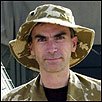
Dr Andrew Murrison MP - Conservative MP and Iraq war doctor
Dr Andrew Murrison
Question: To set the background: you actually served in Iraq recently. How long were you out there?
Dr Andrew Murrison: A month. I was a medical officer working with the Army at a port called Az Zubayr.
Question: Was that one of the first places to be liberated?
Dr Andrew Murrison: It probably was because it's the next stop from Umm Qasr to Basra.
Question: How much did you get to see of what was going on?
Dr Andrew Murrison: Well, I saw a fair amount. I covered quite a lot of the territory during my month. I was obviously primarily responsible for treating soldiers buy I also treated civilian Iraqis and spoke to a very large number of them. I got a fairly good feel for the place, I think.
Question: What's your assessment of what actually happened, in the short conflict and its aftermath?
Dr Andrew Murrison: As predicted the conflict didn't last very long and the outcome was pretty well pre-determined. The difficulty has been managing the situation subsequently. I think we have some significant problems in that respect, some of which are related to a number of assumptions we had made in the run up to the conflict that have subsequently been shown to be incorrect.
In particular the assumption that large tranches of the Iraqi army would defect to Coalition forces and could be used as the basis for establishing security forces that would allow Iraq to stand on its own two feet. That didn't happen and we've got a real vacuum.
Question: Why do you think that was?
Dr Andrew Murrison: Well, I think that the nature of the Iraqi forces was such that they were a conscript army, a very unwilling army. Given the chance it just melted away and people just went back to their homes.
Part of it was, I'm afraid, a result of the attitude taken by the Iraqi governing council and the Americans after the war that you had to completely remove the Ba'athists from all elements of the public sector. It's a very laudable, purist aim to have but in practice what it's meant is that you've stripped out a whole layer of middle management within the public services with nothing much to replace them.
It seems to me that a more conciliatory attitude might have been taken to those who were members of the Ba'ath party only to advance their own careers, rather than through some political philosophy.
Question: How strong was that loyalty to the Ba'ath party?
Dr Andrew Murrison: I would certainly say that there were a large number of people employed in the public services in Iraq who were party members in order to have the tick in the box that allowed them to advance to the next stage in their career rather than because they were die-hards.
Question: What was the feeling among Iraqis about the war?
Dr Andrew Murrison: The interesting thing was that local people were at best ambivalent towards coalition forces. Certainly with the ones I spoke to, there was no great enthusiasm for the current occupation. I think any toleration that ordinary Iraqis have to coalition forces is very conditional. It's conditional upon an early withdrawal.
For as long as this goes on and on, I think that sympathy is going to wear more and more thin. That's the worry.
We are potentially facing a deteriorating situation because once we've lost the sympathy and support of the mainstream swathe of Iraqi people I think we're in deep trouble. That will allow a fertile ground for unhelpful elements - both indigenous and those who are coming in from neighbouring states.
Question: Was there much evidence of the irregulars and foreign fighters?
Dr Andrew Murrison: Certainly one was aware of their presence. I think you need to appreciate that South East Iraq is relatively trouble-free. It has been throughout the conflict and remains so. It's in part due to its social make-up, it's religious make-up and in part it's due to the way in my view the British forces have conducted themselves.
Question: The message from the media and the Bush administration was that forces were greeted with cheering crowds treating them as liberators. Has the media been co-opted?
Dr Andrew Murrison: The media has a very long history - if I may say so - of being co-opted into war efforts of various sorts. It would be surprising if this one wasn't an exception.
What I would say is that there were no scenes of mass rejoicing when I was in Iraq.
Question: Given what you've said about British troops, what are the lessons here for US troops?
Dr Andrew Murrison: The Americans, to be fair to them, have had a harder nut to crack.
However, part of that is due to the way the British have approached the issue. Sadly they've had 30 years of experience of not dissimilar activities in Northern Ireland. To be honest the British army is fairly expert at the kinds of counter-terrorism that it's now being asked to carry out.
I think it would be very foolish of the Americans not to take note of the way the British have conducted themselves given our experience and our obvious success in managing a sector of Iraq in a peaceable way.
Really and truly, I think that the hard hat approach of the Americans can be counter-productive. I know they have a very difficult sector to patrol but nevertheless it isn't helpful if all you do is bunker down and are driven to spend most of your time protecting yourself, rather than getting the job done.
In the South East the British are active out there in the community, they are talking to people, they're negotiating and I think they are reasonably accepted. There are lessons to be learnt.
Question: Do you think the US high command under-estimated the challenge they faced?
Dr Andrew Murrison: I think it was entirely predictable that America would win this conflict without too much difficulty. I have to say I was pleasantly surprised at the low level of coalition force's casualties. I had rather feared that they might be a great deal higher - so that was a blessing.
I suspect that the American high command thought that after the war had been won it would be easier to stabilise the country. That security forces would be in place sooner, that Iraq would be showing signs of being able to run itself sooner and that we would now be looking seriously at free and fair elections.
To be honest it seems unlikely in the extreme that free and fair elections will be conducted while the security situation continues to deteriorate.
Question: The Bush administration is looking at scaling down its presence and holding elections within the next six months. Is that realistic?
Dr Andrew Murrison: Unless President Bush can pull something out of a hat, it seems to me to be unlikely.
Question: What time frame would you put on the coalition's stay in Iraq?
Dr Andrew Murrison: I would be very surprised if America will be out of Iraq this decade.
Question: When we interviewed you in February, ahead of the war, you were apprehensive about the threat of chemical weapons.
Dr Andrew Murrison: Yes.
Question: The weapons weren't used but the Iraqi source named in the newspapers says they have been hidden away. What's your verdict?
Dr Andrew Murrison: I have to say that after all these months, if all that can be produced is an anonymous Iraqi colonel who is given some extremely vague details about the nature of what he supposes were weapons of mass destruction, I think it suggests strongly that these things were not available at the time in question.
Question: What was the atmosphere like while you was there?
Dr Andrew Murrison: What I was involved with was the post war, what you might call the guerrilla phase of this conflict. There was little or no prospect of chemical or biological weapons being used in that situation because you do need some sort of state structure to use them in any large scale way.
Question: The Hutton inquiry was dominated the agenda here. Were troops aware of it?
Dr Andrew Murrison: No I don't think so. The British Army is wholly focused and very professional. It is there to do the bidding of the government of the day. It takes a great pride in doing a good job. Most soldiers take the view that worrying about the greater political events of the day is not really what they should be overly concerned about.
I don't think the Hutton inquiry, though it is of interest to serving members of the Armed forces, is a preoccupation for them.
Question: How did you manage to deal with constituency issues from the middle of a war zone?
Dr Andrew Murrison: Fortunately, most of my call-up was during the parliamentary recess. So that worked quite well, I suppose. In terms of routine things in my constituency, my colleagues helped a great deal.
I also have an efficient office which fielded quite a lot of the work. E-mail was relatively available in Iraq and I did a lot of my business that way.
Question: It must have been quite strange dealing with issues like Laylandii hedge disputes in the middle of the desert.
Dr Andrew Murrison: You're right to point out Laylandii trees. It was slightly unreal, I suppose you could say. But nevertheless it was a welcome part of my daily life out there, dealing with the constituency matters in that way. Now I'm back I've caught up.
Question: Is this the way forward for all MPs?
Dr Andrew Murrison: As a way of being able to deal with things quickly! No. I think the thing you value about being a constituency MP is the personal contact. With the best will in the world you can't do that electronically in the long term.
|