|
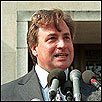
Dick Morris - Former adviser to President Clinton
Dick Morris
Question: What is your relationship with the UK Independence Party?
Dick Morris: I'm working with the UKIP on the European parliamentary election in June. Our hope is that we can send a very convincing message to the Conservative Party, to the continent and to the Blair government that people want a vote on the new constitution and that people want a free trade area and not a loss of sovereignty.
There is nothing that could send that message better than a party that got no points in the last election getting 20 or 25 per cent in this election.
Question: So you wouldn't accept the government's argument that the deal that they did manage to reach in Brussels didn't involve any loss of sovereignty?
Dick Morris: The constitution as it is now formulated certainly does involve a loss of sovereignty. The most important thing is that it delegates to the Europeans the decision as to what is a federal law and what is a local law.
We have that system in the United States and it permits an override of local legislation.
So when you have one foreign minister you have one foreign policy. Each nation having a veto is quite beside the point.
Britain could never have invaded Iraq on a veto. Britain needed the ability to have its own foreign and military policy, not simply a veto on somebody else's policy.
It's a formula for not having a foreign policy and as an American I'm pretty glad that it had one.
Question: Will a deal, if it can be done on the constitution, pull Britain further away from the special relationship?
Dick Morris: Yes I think it would. I think anybody who even glances at a map of the world would see that the English channel is wider than the Atlantic ocean.
The Atlantic ocean has narrowed and the English channel has widened.
Question: Following the capture of Saddam is President Bush's re-election now guaranteed?
Dick Morris: No, I don't think there is a cause-effect. I think it certainly ups Bush a great deal.
I think it means that there will be a focus over the next few weeks and months on Saddam's crimes rather than on the attrition rate among American and British forces.
I think that is going to be very helpful to President Bush and to all those who supported the invasion.
Question: Is it still the economy, stupid, or is national security and the war on terror post-9/11 now more important for Bush and Blair?
Dick Morris: As problems are solved in the United States they tend to drop off the radar screen. Our economic growth in the last quarter was over eight per cent, which is fairly typical of an under-developed country, not of an industrialised country.
And economists are predicted that the next year will be one of the most robust for many years.
So I think by election day in 2004 the economy will really not be a factor except a positive one in Bush's direction.
And Bush is tremendously helped by the candidacy of Howard Dean who is likely to emerge as the Democratic candidate.
If you ever wanted proof that God is rooting for Bush, look at the fact that he gave Dean the Democratic nomination.
Question: Do you think that is sewn up now?
Dick Morris: I think Dean will win it and I think he is probably the only candidate among the Democrats who has no chance at all of beating George Bush.
Question: So the Dean candidacy is not something you would advise the Democrats to pursue?
Dick Morris: No, they had perfectly good candidates in Joe Lieberman who was pro-war and would have, or could have, defeated Bush I think.
They had Wesley Clark a general, who was certainly formidable as an opponent. Even John Kerry would have been better.
But Dean's opposition to the war in Iraq makes it very difficult for him to win.
Also, his position on allowing gays to marry is very different from the majority of American people who oppose that.
Question: Are the other candidates "good" in terms of losing for the party gracefully or in terms of having a realistic chance of beating Bush?
Dick Morris: Lieberman and Clark could have given Bush a very tough race and could have defeated him.
But I don't think there is any chance of them being nominated now, I think Dean pretty much has that wrapped up.
Question: You've written extensively on e-campaigning. In what ways has the Dean campaign changed the nature of this?
Dick Morris: The Dean candidacy for all of the difficulty that it is going to have in elections against Bush, his ability to come from nowhere and get the Democratic nomination, to vault ahead of five other candidates who are ahead of him is extraordinary and is almost entirely due to the internet.
I think it is the beginning of the internet age in American politics and the end of the media age.
Dean basically was shut off from any financial contributions from any of the usual heavy hitters, the wealthy donors and the special interests because everyone assumed he had no chance of winning.
But he was very enthusiastically supported by the gay community, because of his signing of the gay marriage bill, and the anti-war community because of his opposition to the Iraq war.
And they networked within those communities and got hundreds of thousands of people to become deeply committed to Dean's campaign.
So where Gephardt or Kerry or Clark have 30,000 or 40,000 campaign contributors each, Dean has 300,000 campaign contributors.
So he literally has broken the control that the special interests and wealthy donors had in American politics and proven that it is faster, better, cheaper and obviously more ethical to raise your money from a large group of people giving a small amount each than from a few individuals trying to buy their way in to very special access with huge contributions.
Question: So that is something you welcome in terms of the Dean campaign?
Dick Morris: Yes, whatever the fate of Dean's candidacy, his contribution to the reform of American politics gives him a place in history.
He literally has broken the cycle of bribery through campaign contributions that has come to typify both political parties.
Question: Is that something you think he foresaw or was it a fortuitous benefit of his policy position?
Dick Morris: I think that he may have foreseen that his policy position may have given him unique access to certain groups on the Democratic Party's left.
But I think it was the contribution of his brilliant man who is running his campaign, Joe Trippi, who succeeded in convincing him that he could translate that into immediate financial support through the internet.
Candidates in the past have attempted to use direct mail and telemarketing by phone as a method of circumventing the special interest monopolies on money.
But they don't work because they cost you about 50 cents to send out a mailing. It costs you a little more than that to telephone somebody.
So you have to get a huge response to even pay for the cost of the solicitation.
But online it's free. And therefore the internet has proven to be an incredibly effective vehicle for raising money and I think it is about to prove it is a very effective vehicle for getting votes.
Because I think Dean is showing as he takes the lead in these primary states, with television, but mainly with the internet, that using the internet to raise money for television, is like using the air force to bring troops into combat.
It can do that but there is a lot of other stuff an air force can do for you and Dean is just beginning to show the rest of the country what it can do.
Question: What lessons can British parties learn from the use of the internet in the US?
Dick Morris: The era of internet politics is going to sweep the world. A politics that is customised rather than uniform, that is driven virally at the grass roots, rather than a top-down kind of thing and politics that really permits people to speak their own views rather than have them spoon fed from on top.
I love what the UKIP is doing in the internet, because they really are trying to represent a movement that is largely unrepresented in the media.
Because the elite media is so deeply committed to the concept of European integration, I don't think they give the opposition that probably is the majority of the British people a real chance to speak.
And through the internet they are getting that chance. It is leapfrogging the traditional channels in much the same way that the Dean campaign did.
Question: Is the culture of internet politics going to help smaller single issue and insurgent parties break through the two-and-a-half party monopoly we have in Britain?
Dick Morris: Exactly, because you know longer need to afford massive amounts of upfront money to publish your positions, to mail them, to phone them, to buy television commercials.
You don't need that, communications are free. It will have a tremendous effect in devolving, to use Blair's favourite word, political power.
Question: How should the major parties respond to this challenge?
Dick Morris: I think that that they obviously need to develop their cyber links and networks.
But I think that they are going to find that those networks are rather atrophied, in the case of the Conservative Party in particular because it doesn't stand for anything.
It's not anti-Europe because it has lots of pro-European people in it, it's not in favour of a tax cut because it can't get itself together to urge that and it's in favour of the Iraq war but so is Labour.
There really is no basis on which to appeal to the average voter, except perhaps a dislike of Tony Blair.
To use the internet effectively as a grassroots tool, you have to have something to say. You have to have clear positions on issues that are attractive to the voters.
And the modern political parties that are heterogeneous coalitions of divergent points of view, that hammer out a consensus and a compromise make it very difficult to really say anything over the internet because you can't really say anything very strong.
Question: Is the Dean defeat that you are predicting going to pave the way for a Hilary Clinton challenge in 2008?
Dick Morris: Yes I think so. However I would not rule out the possibility that Hilary might run for vice-president this year.
The Clintons, the two of them, have opposed Dean strenuously in this process.
Wesley Clark was basically put into the race by the Clintons. The whole Clinton staff operation is now effectively working for Clark.
Before that they were working for Joe Lieberman who ran as Gore's vice-president.
Bill Clinton has said that the two stars on the Democratic horizon are Hilary and Clark.
Clark has really fallen apart, he is running a distant second in most places and in some places fourth or fifth.
So the Clintons really have a nominee that they don't like in Howard Dean.
For Dean that represents a tremendous threat. Because when he's out running the Clintons control the Democratic machinery and most of the Democratic elected officials and it threatens to be a re-enactment of what happened in 1972 when George McGovern got the Democratic nomination on an anti-war platform and the party was supporting Hubert Humphrey.
Dean may have to take a hostage to make sure he does not get knifed in the back and what better hostage than to put Mrs Clinton on his ticket.
And Hilary may want that to happen because she may want to be attractive to the left wing that is basically taking over the Democratic Party, by being seen publicly as giving Dean a boost.
Al Gore just endorsed Howard Dean, which is really in effect a statement by him that he is going to run in 2008 against Hilary for the nomination.
Question: Is Blair the last great hope of Third Way politics? Why did the Clinton era of centre left leaders decline so suddenly?
Dick Morris: In all politics we alternate between consensus and disagreement. When we find new political issues and challenges we don't want consensus.
We want disagreement to flesh out the two points of view. Then our countries come to a consensus and that then becomes the third way, solves the issues and then we move on cyclically to a period of disagreement and divergence.
I think Bill Clinton and Tony Blair passed and solved the problems that they faced before they became president and prime minister.
In Blair's case, how do you deal with labour unions, how do you deal with the shrinking role of government in a capitalist society, how do you deal with the needs of defence and an aggressive foreign policy as a liberal and progressive politician.
And Bill Clinton dealt with the issues of crime, the budget deficit and reforming welfare.
They solved those problems, they tended to adjudicate them along the lines of the third way.
Then a hold host of new issues broke out, led by the war on terror and also the issue of European integration.
When those issues come out, people are not in the mood for a third way. They want the two ways fleshed out so they can make their decisions.
Then you enter a period where dialogue is necessary as opposed to consensus.
And then after the public's heard enough dialogue they come to a consensus and the market is open to a third way politician.
So I think they accomplished their purpose and I think we will revisit that purpose a little way down the road.
But right now we want to hear the divergent arguments on Europe and on terror.
Question: Has September 11 brought in a new era of conviction politics in place of focus groups and triangulation?
Dick Morris: We all still do focus groups and polling and we all still position ourselves for maximum advantage.
But it did definitely bring in a new era of conviction politics on both sides of the fence.
And I think that the British people and the American people want that explored.
They want to hear from the left about the contracts Halliburton is getting that it shouldn't be getting
They want to hear from the left as to why we were misled on the issue of weapons of mass destruction.
They want to hear from the left as to why it's a good idea to integrate Europe and to speedily transfer power to Brussels.
But they also want to hear from the right about the threat that remains from terror.
They also want to hear from the right about how to cut back on asylum and re-assert our national sovereignty.
And they want to hear from the right about the surrender of power to Brussels and why we shouldn't do that.
And after they have heard those discussions they will then come to a decision.
Because we are not Japan we have dialogue and because we are not France we reach consensus.
Question: Can Blair continue to triangulate between the two or will he eventually have to make up his mind?
Dick Morris: No, I think Blair has made up his mind. And I think one of the reasons for his drop in popularity is that his position on Europe is basically unpopular.
The media would like to attribute his drop in popularity to Iraq, because they are anti-Iraq and pro-Europe.
But the polls show that most British voters are pro-Iraq and anti-Europe and I think that is draining Blair of his support.
I don't think Blair is triangulating at this point any more than Bush is. They are both strongly pro-war, strongly anti-terror and in Blair's case strongly pro-Europe.
Question: Are the Labour Party going to ignore the lessons of the Democrats as you have outlined them and choose a candidate who appeals to the party but not to the country as a whole after Blair?
Dick Morris: They could and Gordon Brown certainly begins to fit that bill.
But that would depend on whether the Conservative Party abandons its mushy position and in fact stands for something.
There is a national crusade waiting to be led in this country, which is a crusade against the bureaucratisation of Brussels and a statement for democratic rule by elected people who actually get votes, not self-appointed bureaucrats who create the rules.
There is a mandate for lower taxes, not Britain moving in the direction of the higher tax continental countries.
There is a mandate for the exercise of sovereignty in foreign and military policy.
And no political party is giving that mandate, giving that desire a voice.
The Conservatives are giving it a little more of a voice than Labour is but they are both coalition parties straddling those issues.
And the interesting thing about the UKIP is that it is the only way the British people can say no.
We are planning as our election slogan "How do spell no in English: UKIP". It might be the only vote they ever let you cast.
Question: So is Gordon Brown the British Howard Dean and is Michael Howard the British George Bush?
Dick Morris: Well Howard's not the British George Bush because Bush clearly stands for things.
He has clear and aggressive views on important issues. Howard straddles the European issue and won't come out for a tax cut and has all kinds of ifs and buts in his position.
He more represents Bob Dole, the consensus leader that doesn't articulate strong policies and fails.
Gordon Brown may well be the British Howard Dean.
But I think what's going to happen is that UKIP is going to rack up an amazing vote in the June parliamentary elections, almost precisely because the European parliament doesn't mean a hell of a whole lot.
It will be a symbolic vote for a symbolic body for a symbolic party against Europe and for going slow a for reversing some of this direction.
And I think that that is going to cause a re-orientation among the two other existing parties and by the time the smoke clears I think you will find the Conservative Party a strong reliable voice against European integration.
But I do think that it first has to go through the process of being humiliated by a decisive vote for the UKIP to teach them how their constituents feel on this issue.
Question: So Howard needs to ditch the pro-European wing of the Tory Party?
Dick Morris: Yes, the Conservative Party needs to become smaller before it can become bigger.
|