|
Blunkett to head ID card campaign
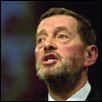 |
| Blunkett: Ready for poll |
David Blunkett has said he will lead Labour's election fight on ID cards.
The former home secretary, who has been given a key campaigning role by Tony Blair, told the Independent that he would spearhead the party's drive on the policy he pioneered in government.
With polls showing the public four to one in favour of the plans, Labour will hope to capitalise on Tory and Liberal Democrat opposition the the idea.
Ministers believe the cards would help protect against immigration abuses, terrorism, crime and access to services.
With Labour's campaign having started badly, Blunkett also said more needs to be done to unite Blairites and supporters of the chancellor Gordon Brown.
"We have to bridge the gap between stick your feet in the mud and defend what is already happening on the ground at all costs and [those who] think up anything that gives the impression of modern change," he said.
Academic attack
In a blow to the government's plans for ID cards, a study from the London School of Economics concluded on Monday that the scheme would be damaging to business, cost far more than initial estimates and could actually worsen security.
The current proposals "must be" abandoned, it found, as they could actually increase security threats and are "too complex, technically unsafe and overly prescriptive".
The academics also warned the plans are likely to be far more expensive than the government's estimate of £5.5bn over 10 years.
But a separate survey carried out by Populus for Fellowes International found that 81 per cent of the British public are concerned about becoming a victim of identity theft.
"It is the fastest growing crime in the UK and urgent action is needed to educate the public on the simple steps they can take to protect themselves," said Conservative MP Nigel Evans.
"That is why MPs from across the UK are calling on the government to issue clear guidelines to individuals and businesses, detailing the most effective ways to destroy information containing personal details."
Terror fight
In the interview Blunkett also defended his record in office on fighting terrorism, including the controversial Act brought in the wake of the September 11 attacks and ruled in breach of human rights by the law lords.
"People might get a shock; those who say there was no threat will have to eat their words," he said. "There hasn't been an attack on Britain because of the work of the intelligence and security services.
"People will look back and say 'thank goodness we protected ourselves', not [just] because we prevented individuals and their network from attacking, but because we made a difficult environment for them and were not a soft touch."
He argued that criticisms of his failure to produce revised plans earlier had led to the parliamentary debacle over his successor Charles Clarke's new control orders.
"There were three reasons why we weren't able to act prior to 16 December - one was that we had won unanimously in the Appeal Court chaired by Lord [Harry] Woolf, the lord chief justice," he said.
"And therefore we had a pretty good presumption there was a senior coterie of judges who believed that - while there was a case for saying the Act was discriminatory because we had debated it - it was proportionate.
"Second, the attorney general [Lord Goldsmith] quite rightly said that if you put anything together that was an alternative to Belmarsh and Broadmoor you will immediately undermine my case with the law lords. Given the history of leaks from the Home Office and the Cabinet Office, he quite rightly counselled us against attempting to do that.
"Third, I had published a consultation paper on acts preparatory to terrorism and floated the idea of orders that would allow controls to be put in place which, if broken, would allow the introduction of the criminal law, which is partly what is now planned.
"I challenged, at the time of that consultation, if people thought they had smart ideas they should come forward with them. There has been a deathly silence.
"I understand why people want someone to blame, but neither Charlie nor I are to blame on this occasion."
|


